The Sqaure (2008): A Bad Idea From Step One

•May 30, 2011 • Leave a Comment

Have you ever noticed how film genres tend to ebb and flow in popularity? A genre long forgotten or disparaged will cycle back through the public consciousness, usually following an exceptional (or exceptionally lucrative) entry into the canon. And unfortunately, as worthy as the entry is that reignites our passion for the genre, the standard rule is that all untalented hacks will then attempt to cash in on said revival as quickly as possible, leading to genre fatigue stemming from a stream of sub par movies. The last decade, romantic comedies received an unexpected champion in Judd Apatow, who can also be held responsible for the 80,000 bromances released in the past few years. Wes Craven has singlehandedly revived the slasher genre twice (A Nightmare on Elm Street [1984] and Scream [1996]), and destroyed it too many times over to count (the latest offender, Scream 4 [2011], lends solid evidence to the theory that Craven is out of ideas). I wouldn’t be surprised if the Western genre were to witness a brief revival after the Coen bros tackling of True Grit (2010), the same way Unforgiven (1992) was followed by Bad Girls (1994), The Quick and the Dead (1995), Wyatt Earp (1994), et al.

Film noir seems to work differently, perhaps because noir doesn’t attract the same large audiences. I can’t think of the last film that dabbled in noir conventions to hit it big at theatres. While a part of me mourns that these movies don’t register on a larger scale, it also means that I have yet to live through the noir inundation trying its best to strip me of any love I have for the genre. Noir films don’t come along often, but when they do, they tend to be tightly written little gems. The latest of which, The Square (2010), is my focus today; an Australian entry into the noir canon directed by Nash Edgerton.

Synopsis: A man and his neighbour, with hopes of leaving their partners and running away together, conspire to steal a bag o’ cash from her meth running husband to fund the venture.

A film noir, in its most traditional sense, plays as a cautionary tale. Typically, the central character is a prosocial person; they may not be all that ethical, but rarely are they criminal. Often they are white collared professionals, looking to make life a little easier, or more commonly, make life a little easier for the dame they’re so desperate to impress. They never seem to understand the world they’re attempting to infiltrate, yet rarely doubt their ability to emerge unscathed. These characters don’t know how black the world can be; even the worst they see is mostly grey. The traditional noir story follows our hero(ine) as they become more embroiled in the criminal world, and their plan spirals increasingly out of control. The hostage turned to me at one point and said, “that was just a bad idea from step one,” which I thought could almost be the noir crest motto. I might even go so far as to call them modern-day morality plays – don’t try to cheat your spouse/partner/boss etc., or look what’s in store for you! It seems an unwritten rule that these stories end darkly.

As things spiral wildly, we gain an understanding of who our protagonist really is. Mostly, the hero(ine) spirals out of control with their plan, making more and more mistakes, becoming more and more afraid and ruing their involvement in such a stupid idea from the beginning. Such a progression is realistic; we prosocial folk learn how to live in a law-abiding world with structure and reason. Criminals learn to live in their own world, a world where the police will as likely hurt as help you, a world where you can’t even rely on your parents for protection, a world where safety is a foreign concept. This is a world in which violence is more than an option; often it is the option. Recently I was speaking with a violent offender who was floored to learn that I had never once in my life been hit; he was not even aware such an existence was possible, as violence had permeated his reality from childhood. Obviously, while both raised on planet Earth, we come from two drastically different worlds. In noir, our protagonist occasionally discovers how well suited they are to this world of thieves and murderers –  rather than drowning, they find a way to tread water, usually with further criminal activity (Breaking Bad, when are you coming back to me?). In The Square, our hero Raymond seems to fall into this second camp. The violence he encounters in the criminal world overflows into other areas of his life, such as work, and when it appears he may be caught, he chooses not to do the right thing.

The Square is a film that respects and adheres to the noir conventions, but has updated the style to achieve a gritty realism. In addition, Edgerton has thrown in a few new twists. Without giving too much away, let’s just say I spent the entire flick trying to figure out if Carla was playing Raymond in traditional noir form. The Square suffers somewhat from my recent viewings of Winter’s Bone (2010) and Double Indemnity (1944), two nearly perfect films. Still, it is a solid take on the genre that any fan will enjoy.

One last thing, has the white trash meth industry replaced the mafia, and no one told me? It’s getting to the point that anytime you need a big bad organization in the midland, just go knock on the door of your local trailer park meth drug lord. Is this for real, or just in the world of TV/movies?

Until the next,

K

Hostage Pick: Mega Shark vs. Giant Octopus vs. Mega Shark vs. Crocosaurus

•May 22, 2011 • Leave a Comment

Good day all,

I have to open by apologizing for taking so long to send my two cents to y’all, but things have been a little awkward around the bunker since my little grasp at freedom and resulting wilderness adventure. The Lady has been really cool about the whole thing; in fact, it was just the matter of my complete and utter mental breakdown as I worked to accept my fate that kept me from writing. I played tough, but deep inside the inner-hostage was crying. She spent some time rebuilding my psyche and, as a reward, she let a cracker choose what to watch. My choice was probably a little hampered by the whole drooling, psychological recovery thing (think Dewy Cox needing more or less blankets) and decided to look at the Mega Shark movies. My understanding of the whole thing is that the Sci-Fi Network paid to have some bad, 50s style monster movies made; the intent being to re-create the monster, B-movie for the 21st century. The result is a couple of movies that you will either hate or love based on your world view; optimists will see actors who had a very brief moment, holding onto the dream, while pessimist will see the worst of the d-list performing terrible words with computer graphics just below that Discovery Channel show where they pit different animals against each other in cyber-battle (awesome). In either case, these two flicks are the most engaging train wrecks you could hope to fill three hours with and each has a clear nod to a well-known director that made my evening. These two flicks are the modern incarnation of the hideous bastard-child spawned by Godzilla movies and Ed Wood Jr. (that jolly, cross-dresser), and I mean that as a compliment. I will also be handing out the first annual “going for it” award for each film, acknowledging the has-been that has the commitment, if not the skill, to rise above some truly shitty acting (a little). Here we go:

Mega Shark vs. Giant Octopus

Picture the scene: Deborah Gibson is at the helm of a two-person submarine, researching whales, taking in the “poetry” of some clearly stock footage left over from BBC’s Blue Planet (Ed. Wood nod), when the whales start rushing toward a glacier killing themselves. This mad behaviour could be caused by an illegal, sonar beacon . . . . or . . .  it could be a giant shark chasing a giant octopus chasing a pod of blue whales (and eating the shit out of them). The only thing to erase the trauma for Deborah is brown-bagging cheap whiskey on the beach with her fat co-pilot (who is set up as a best friend, and then never heard from again). The government recognizes her marine biologist chops and calls her team in to help battle the giant sea creatures. The film boasts not one, but two (two!) scientific research montages, with the first cutting to black and white repeatedly in a clear nod to Oliver Stone (I kept waiting for Deborah Gibson to shoot Jack Ruby). Deborah has the good fortune to find love with a Japanese colleague, and you know it’s real because they have the same type of immediate connection as Romeo and my toenail clippings. One point I must concede is that our heroes realize that the key to luring the two creatures into battle, the only hope for the planet, depends on pheromones after banging in a broom closet. This is the exact opposite of how awesome it sounds, and leads to the second research montage, but does hold true to my belief that random hook-ups will save the world. I don’t want to ruin the ending, but let’s just say the battle is everything you would expect based on the production values, but it is so incredibly bad in such an incredibly awesome way that I felt myself getting pulled in.

As far as high cinema goes this thing is a piece of shit. The effects are absolutely terrible, like the graphics the Daily Show created for the royal wedding, but awkwardly mixed in with models (I think, it was too shitty to tell). The writing is a string of clichés and scientific babble that wouldn’t fool a nine-year-old (think the psychologist on Criminal Minds), and most of the performances are hack at best. There are a ton of re-used shots, some flipped to fool you, and they actually try to sell the exact same fight scene at two different points (the octopus has the shark in the same triangle choke until the shark bites the same leg off). All-in-all this thing is an absolute mess, but it is saved by hope. Every person on this shoot, much like the folks that worked with Ed Wood, believe that this movie is their shot. Some are c-listers that had a taste of recognition, some are never-will-bes and, I’m sure, even the guys holding the cameras are hoping this ridiculous mess will lead to another job. The players hold it just straight enough to make it so ridiculous that you have to love the ride.

The winner of the “going for it” award for this chapter is Lorenzo Lamas. You have to feel for the guy, I mean he had some t.v. success with Falcon Crest and Renegade, some recognition and a little fame, so this turn has to be a little rough. The fact is that this guy plays the douche really well. I’m sure he just looks better compared to the turdstorm surrounding him, but he holds a character and delivers lines in a near respectable way. I mentioned to the lady that this movie kind of reminds me of Avatar, in that it has a believable corporate douche and is a terrible fucking movie. Also, the Japanese Navy speaks English on their ships, and they have some white sailors, and one dude looked like a white guy dressed as an Asian guy (yellowface?). Just thought I’d let you know.

Mega Shark vs. Crocosaurus

Round two begins with Jaleel White as a shark expert working for the Navy. He has discovered a way to impact shark behaviour by broadcasting the sound of dying fish at different frequencies (seriously) and has a breakthrough. We have a chance to meet his smoking-hot fiance just long enough to feel sad when she dies. You see, Jaleel’s breakthrough attracted the still living mega shark and it killed everybody on the ship but our hero. Understandably our hero’s mental stake is shaken, knowing he brought on the attack that killed his love. The only hope to avert his mental collapse is an offer by a crack team to use his shark knowledge to get mad revenge. The only problem is that another giant creature, Crocosaurus, has awakened from a slumber and has laid eggs all over the world. Jaleel is joined by a scrappy hunter/con-artist he was in the Peace Corp. with, and a stern-faced C.I.A. operative that is sexy and can fly a helicopter. By the way, a giant crocodile can be brought down by a two-inch tube of glowing tranquilizer, just in case you run into one. The twist in this chapter comes from the fact that the mega shark is humanity’s only hope against the new threat, as it is attracted to and feeds on the endless eggs of the crocosaurus lays (you see, it rapidly evolved to have more eggs because it was threatened by the shark. For real). Long story short this thing is equally as horrible and awesome as it’s predecessor.

Again, writing, direction, acting and effects are all the cheapest and weakest possible. There are repeated characters and naval vessels that show up just to be destroyed. The nod in this one is a Bad Boys slow-mo turn to see a helicopter that made Michael Bay’s little soldier stand to, as much as explosions do. The best explanation I can give is that the agent flies a crashed helicopter in at the last second to save our heroes from the shark, which is now a nuclear bomb because it swallowed a nuclear sub whole (that’s new-clear, Mr. Bush) before it is consumed and set off by a volcano. The scenes of the monsters reaching and destroying the cities is ridiculous, laughably ridiculous. The “going for it” award for this gem has to go to Jaleel White. He tries to play confident, unraveling, powerful and brilliant, and while he never quite nails it he tries really hard.

Well folks there’s my double feature and I hope you have the guts to give these a try, because there is something about them that leaves a positive residue. Much like the ninja flick I wrote about recently these are terrible films that have a heart that’s kind of fun. It kind of makes sense that I would reach out to movies that represent the last dream of a lot of untalented people, and I would walk away pulling for them, based on my turn of fate, but I really was engaged by these horrible films. At worst they made my life seem bearable by comparison.

Until the next time, fellow readers, keep living the dream,

The Hostage

P.S. Check out Wizard People Dear Readers, it’s bloody brilliant.

The Work of Director Spike Jonze (2003): When MTV Played Videos

•May 16, 2011 • 2 Comments

Some filmmakers, like writers, seem to produce their best work in short form. This is how I feel about Stephen King; there’s a level of menace, of ugliness, to his short work that is absent in his novels, which always need to end on some act of heroics, with the protagonist saving the world (or increasingly so; King left the world of quiet, intimate horror decades ago). I recall one short story from Skeleton Crew titled “Survivor Type,” about a shipwrecked man who slowly severs and consumes increasingly important body parts to stay alive – there is not a happy ending. Ugh. Also, kind of awesome. Even in his modern short stories, he appears comfortable letting the ending be sinister, scary, hopeless – which he would never permit in a novel. I must be drawn to the macabre, as this is the only time I enjoy reading King’s work. (Sidebar: I have a theory that my gumdrop, lollipop, and sunshine upbringing is the reason I’m so attracted to dark matter, whereas those who have actually experienced the macabre in life can’t imagine revisiting it for entertainment’s sake. It’s the same reason I’ll never write great fiction. Thanks a lot, loving parents.)

Spike Jonze is a rare example of a filmmaker whose short work I enjoy more than their feature length movies. However, in this case, it is merely a situation in which his short films are so inventive, original, and off the wall, that they trump his nearly as excellent feature films. Being John Malkovich (1999) and Adaptation (2002) are fantastically entertaining flicks, but there is something about the freedom provided in short form that really lets Jonze go wild with ideas. I mean, just see what he can do with an Ikea commercial. That is, quite possibly, my favourite commercial of all time. His comment about how crazy I am to care for the lamp only makes me even more concerned for it.

The hostage and I ordered The Work of Director Spike Jonze (2003) to revel in his absurdity. The collection contains numerous music videos, as well as several short films and documentaries. On any collection of this sort, you are bound to have a few missteps, and Spike Jonze is no different from any other director in that some of his pieces work better than others. However, en masse this is a collection of intensely enjoyable oddities. I’ve noted my personal highlights below:

Music Videos:

Drop by Pharcyde: Jonze has a tendency to work with interesting underground artists as opposed to mainstream stars. I’m not sure if this is because the artists are more attracted to his novel video style, or if he personally chooses to work with the underdog, but it means that often beyond the music video, the music itself is of good quality. This video for Pharcyde is several long sequences filmed in reverse, and then spliced together. It is very fun.

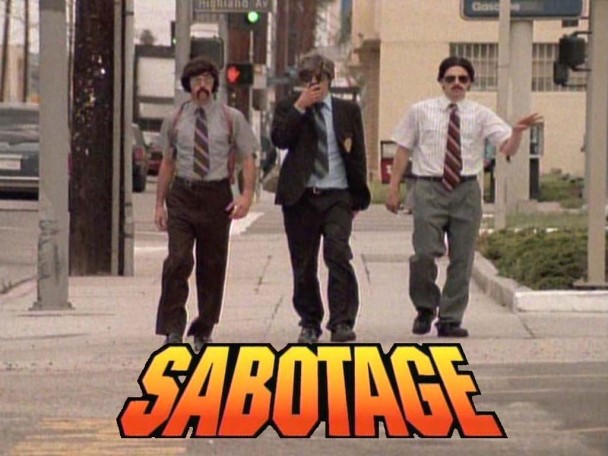
Sabotage by The Beastie Boys: I know this is a bold statement, but I think this is my favourite music video of all time (no disrespect to John Landis). In it, each member of the Beastie Boys takes to the street as a member of the police squad… from 1976. This video is a brilliant send up of 70s cop action shows, complete with cheesy costumes and glued on moustaches, high-speed chases, and ridiculous police names (ex: Cochese and Bunny). The footage is edited together to appear as the opening credits to the cop program. In addition, the music fits the action perfectly, with the police drama rising in sequence with the musical drama. And the Beastie Boys could not have thrown themselves into it any better; they are having ridiculous fun. It is an example of an ideal marriage between song, concept, and execution.

Feel the Pain by Dinosaur Jr.: Watch as the band members play a game of slash golf throughout New York City; just don’t get in the way of their ball – these guys are serious about playing where they land. And this video is seriously funny.

Sky’s the Limit by Notorious B.I.G.: I had never seen this video before, and at first glance, it seems identical to any other rap video: gorgeous production values, huge mansions, pool-side parties, cars, boats, furs, jewellery… this does not seem like typical Jonze. But it is, because every person in the video, whatever role they are playing, is a child. I am convinced it is Jonze’s sharp commentary on the world of the rap star – little children playing as adults – but perhaps I’m trying to see meaning where there is none. Maybe Jonze just thought it was a fun idea for a video, and it is. The kid who plays Biggie is outrageously deadpan in his gansta sneer. Meaning or no, it’s still a great video.

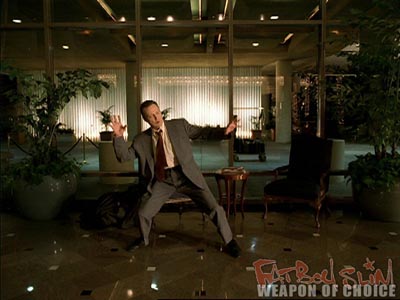
Weapon of Choice by Fatboy Slim: Sometimes the simplest ideas yield the best results. This video consists of nothing more than Christopher Walken dancing through a hotel, and that is all it needs.

Shorts and Documentaries:

How They Got There: Jonze’s ability to tell a fully fleshed out story in mere minutes is a wonderful gift. Here we see how horribly wrong a charming flirtation can go. Jonze’s whimsy is never overwhelming, because whenever it starts to tiptoe towards “too much”, he cuts your legs out from under you.

What’s Up Fatlip? (1999): This is a half hour documentary on Fatlip, the former lead singer of the Pharcyde, compiled through interviews conducted during the course of filming a music video. At one point, the Pharcyde (and thus Fatlip) was very famous. Now he is facing the reality of the music business, as his solo career has not taken off in the same way, and he sees his days as a professional musician coming to an end. Listening to Fatlip harkened back to the interviews with McNamara in The Fog of War (2003); there is a similar kind of frank self-exploration going on that I both admire and appreciate. Fatlip examines his life, taking stock of how he used to think and how he sees things now. He cites learning that Tupac Shakur and Notorious B.I.G. were not as they were marketed as a turning point for him: “when I found out these artists I respected weren’t real killers, it was a relief.” This kind of honest expression is always interesting to watch. As the film ended, I was struck by how intelligent and talented people with something to say rarely make it big in music. That seems so backwards to me.

The Dud: 

Amarillo by Morning (1997): Of all the pieces we watched, only one was a disappointment: a short documentary on a day in the life of several suburban cowboys. In the brief description on the DVD menu, we are told that these young cowboys grew up in a hip hop community and have suffered endless mockery at the hands of their peers. The reality is that they live in Whitebreadville USA, and maybe a couple of kids have said they’re strange for doing what they do. Basically, this flick is Jonze following them about their day (which is pretty much what you’d expect) while they wax poetic about their dreams to be ridin’ free in the rodeo, and speak in tired clichés of all the work they’ve put in and where they want to be in life. I turned to the hostage and said, “I think Jonze finds these kids WAY more interesting than I do.” The hostage rightly pointed out that I grew up with many of these suburban cowboys (and more than a few real ones), and that might be why I wasn’t interested. So I locked him away to punish his insolence.

Until the next

K

The Fog of War: Learning to Live With Your Circumstances. . . . .

•May 5, 2011 • Leave a Comment

Good day all,

I must open by first apologizing for the time since my last communication with all of you; you see I got a little froggy and decided to try and jump the fence. I’d been working at an air duct for a while and eventually found myself crawling upward through an 80 cm (2 and half foot) shaft at about a 40 degree angle (it was slow going and reminded me of The Descent a little). Long story short I found myself standing in a vast, snow-covered forest stretching in every direction. I broke off a twig and stuck it in the ground to create a shadow, marked the angle at its longest and waited for what felt like ten minutes. I marked it again and found what I figured was South between the points (Macgyver was a pussy). It was cold as balls, like really cold, constricted balls, so I wrapped up in the blanket I had put in a bag and tied to my ankle (thank you Andy) and started walking. To properly tell the story I have to play teacher for a moment, sorry if I come across as a know-it-all douche.

You see, I love nature documentaries, especially Planet Earth, Life and Blue Planet. I am fascinated with how life always finds a way and how these bizarre creatures have adapted perfectly to fit their environments. One of the more interesting places on Earth is called the Taiga Forest; it circles the Northern part of the globe through Canada and Russia, and is interesting in that there aren’t enough nutrients available for any life to live on. Huge forests of evergreen trees that stretch for thousands of  miles and are completely void of animal life. It’s eerie to me to imagine a place where there aren’t even insects. The reason I bring up this interesting area is that it was awful quiet as I trudged along. I knew it must be far North because the angle of the sun was really low and the days short. I knew it was Spring, because it was that far North and I didn’t freeze to death immediately. The problem was that there was no life but the trees. After one night burrowed under the snow to avoid pulling a Jack Torrance, and trying to sleep through a makeshift breathing tube, I decided that I should accept my fate and not die. A sense of calm acceptance came over me as I traced my footsteps back to reality, and I wasn’t as angry or defeated as I expected to be. The emptiness reminded me that a bunker with food, good and terrible movies, and a semi-evil woman who has her charms (know-what-I-mean, nudge,nudge) was better than a world without enough nutrients to support a mosquito (I was a little hungry and light-headed by then). Then was I was amazed to see what looked like a six-pack, a bag of beef jerky and a bag of crunchy Cheetos on the path in front of me. There was no hesitation, and then a bug bit the back of my neck. I found out later that she had a snowmobile, a dart gun and a bloody tree stand; I am officially as dumb as a deer. She was almost smug about it back in reality, but didn’t punish a cracker too badly. I knew we were as cool as two people in our situation could be when she threw this movie in. This type of thing, war movies, history flicks and political documentaries in general aren’t really her thing, but I dig’em. Here we go.

The first thing I will say about McNamara is that he has a respectable set of brass balls to sit down and answer questions in as genuine a fashion as he seems to. This guy was one of the most maligned politicians in his time and, really, took the blame for Johnson’s policy. The tape of him telling Kennedy that they needed to be out of the Nam by 1965 completely changed my view of the man. I mean, this guy had the bombing campaigns pinned on him; carpet-bombing civilians in any country (and a couple you aren’t supposed to even be at war with) is some solid war-crime, and to be wrongly pegged in the press as responsible (even for starting the bombing, Nixon brought the nasty) is brutallica. I thought he was the guy that pushed the bombing and he wanted out before the bombing even began. That question “are you a war criminal if you win?” kicked me in the brain like that donkey kicked John McCain in the head (my guess at the recent dementia). He has to sit there and take responsibility for being the guy making the tough decisions, in the moment, knowing that a lot of people are going to die from it. When minimizing death in the thousands is your job, you’ve got a shitty job. I respect the man for making himself accountable for his decisions after the fact, and wish a whole lot more politicians would (imagine the Bush/Harper hybrid that exists in my terrified mind doing one honestly). When he breaks down it is gut-wrenching, and only helps you believe that this guy, trained to lie to the media, is being straight with you; I feel like nobody feels worse for the mistakes than this bastard, and he’s sitting there owning it up to it and crying honestly. I mean the guy was one of the highest paid C.E.O.s in the country, at an almost folksy $800,000 a year, and CHOSE to serve the nation for $29 grand a year. Ask a C.E.O. to do take a proportional pay-cut to serve today (I mean, if he’s not crashing your retirement at 30 to 1 odds and getting away with it). I respect the man and his lessons could’ve avoided a couple of skirmishes now going on (one which our boys are proudly and wonderfully fighting; you can support soldiers and not the war).

The next part of this film that punched me in the noodle like that time Mike Tyson punched Paris Hilton in the face (just a guess) was the conversation about the Cuban Missile Crisis. So at the last second, when the Americans are ready to nuke the world, they get two responses; one a hardline “it’s on” and the other a calmer “let’s talk”, and it was up to Kennedy and this cat to decide which one to respond to. Oh, and all the generals in the U.S. were screaming in favour of going nuke. We all, or almost all, would be dead if not for two men choosing to hear the calmer response. We were that close. Yet the Viet Nam war escalated because of the Bay of Tonkin incident, a mistake in the other direction by McNamara, and millions died because of it. It forced me to look at the decisions these guys are forced to make and the powerful criticism they face for the rest of their lives and hindsight and changing ideas paint their actions as worse than they, perhaps, were. How could this dude look at the Vietnam War Memorial and keep living knowing that an overreaction to false sonar readings led to all those dead? I couldn’t imagine being the guy to make those decisions, but I will continue to criticize the hell out of ’em.

Another tidbit that made the ol’ noggin’ a joggin’ like, people who jog (I think it’s pronounced yogging, a silent J) was a weird idea I had after seeing this. One thing that is easy to overlook is that Mr. McNamara was the bigwig at Ford and helped introduce the notion of trying to keep people alive in a crash to the American Auto Industry. You wonder how his win/loss record works out, like how many lives is he responsible for saving and how many is he responsible, if even partially, for killing. How many lives have been touched by the decisions of this one guy. Power is an interesting creature and the more I hear about it the less I really want it. That could be my feeble brain coming to accept the reality of my return from the outside world. The hopelessness setting in and the bean releasing the happy chemicals to rationalize the rest of my life, you know? But I feel for this guy and admire the seeds it takes to take responsibility for his mistakes and provide a fascinating perspective on his time in office. I learned a lot, and have to say the man has been unfairly remembered as a villain. He made mistakes and the consequences were huge, but I genuinely think he did what he felt was in the best interests of the country and what his President asked of him. Dig it!

Well it was nice talking to you again and I hope you enjoy this gem, until I wriggle loose to write I’ll be sitting here trying to cope with reality.

Cheers,

The Hostage

The Fog of War (2003): Re-examining Our Reasons

•May 2, 2011 • Leave a Comment

Happy elections day in Canada! In introduction to this highly political movie, I should probably preface my comments by stating that if you vehemently disagree with my stance, it’s probably because I am a filthy commie. Well, maybe I don’t lean that far, but I am certainly what would be classified as a socialist; I have zero problem with paying more in taxes so that we have less poverty and crime, and greater equity in quality of life. I even advocate for taxing the wealthy more (collective gasp!). I greatly agree with the idea that everyone can live a life of comfort if we give up the idea of obscene wealth, and I recognize the role luck plays in our position in society and success. So I’m an uber-lefty (although please understand, I don’t associate with any political party; as far as I’m concerned, politicians are the problem with government, and I mean politicians on all sides). As you can imagine, I tend to be anti-war as well. My father once told me, “War is disaster. The only time it is justified is when not going to war would be an even bigger disaster.” Now here’s where people can split hairs. Some would argue the latest Iraq War was justified to avoid disaster; in my opinion, Iraq was merely one of many dictatorships in the region (and not even the greatest threat to us Westerners), and one that committed the majority of its human rights atrocities when it was allied with the West. However, the land was rich, and the despot no longer a friend of ours. To me, any attempt to justify the Iraq War as diverting disaster is spin-doctoring in fine form. Then again, I’m a filthy socialist. May as well be a commie.

I can think of two wars that meet my father’s criteria for averting disaster: The American Civil War and World War II. Both are instances for which I truly believe that NOT going to war would have permitted appalling crimes against humanity to continue on an enormous scale. On the flip side, topping the list of the most useless and wasteful wars in history is Vietnam. Rather than avert disaster, this was one military action that perpetuated it. So then, how would this bleeding heart take to a film in which Robert S. McNamara expounds upon his military career, the man once blamed solely for the Vietnam action? Errol Morris’ The Fog of War: Eleven Lessons from the Life of Robert S. McNamara (2003) awaits…

Synopsis: The former U.S. Secretary of Defense comments on the various lessons he has learned regarding warfare and security throughout his military and political career.

It is rare to see someone so openly willing to explore themselves and their decisions publicly, especially when such decisions have led to infamy or had devastating consequences. Watching this film reminded me of an exhibit I saw at the Tuol Sleng Genocide Museum in Cambodia. In the exhibit, a Swedish photographer who once sympathizes with the Khmer Rouge army looked back on the images he had taken on a goodwill mission to Cambodia during the reign of the Pol Pot. At the time, he believed the Khmer Rouge was creating an ideal communist system, and many of the pictures he took were used in Khmer Rouge propaganda to further their agenda. In the exhibit, for each picture he detailed his thoughts at the time he took the photo, as well as what he now believed was going on given the information he knows about the regime. His stance in the exhibit seemed simultaneously unapologetic and regretful; it was as if he was doing his best with the information he had at the time, but was genuinely upset that the information was used the way it was. I got the sense that McNamara feels similarly regarding his role in the American military machine.

McNamara speaks with a refreshing frankness about his military involvement. He does not try to rationalize away or justify his responsibility for any of the actions he has taken. At one point, he acknowledges that he and the government behaved as war criminals in the assault on Japan during WWII. Yet it appears he was also unfairly maligned by the American people and media. Interestingly enough, although it became known as “McNamara’s War,” all evidence in the film indicates that McNamara was a vocal opponent to the U.S. involvement in Vietnam from the beginning. There are tapes of him repeatedly pleading for an exit strategy, as he and Kennedy had originally planned before Kennedy’s assassination. His official public stance was one supportive of Johnson’s actions and decisions, but when we get behind closed doors… In 1964, following Johnson’s inauguration, a taped recording reveals Johnson chastising McNamara for his and Kennedy’s plan to withdraw American forces from Vietnam. It was not the last time McNamara would try to get the president to consider alternatives, and eventually their dissent over this issue would lead to McNamara leaving (being fired from?) the administration.

McNamara makes an excellent point early on: I cannot now place myself in the mindset of the Cold War. I cannot imagine making decisions that I believed could impact the future safety of all people. While to me, the domino theory was never anything more than an untested hypothesis, this is a luxury I am afforded with glorious hindsight. The impending threat of nuclear attack was neutralized before I became aware such things happened at all (chasing butterflies, playing tag, etc.), and I have no knowledge of what living with such doom can do to a person. So perhaps his gentle treatment of, and forgiving attitude toward, Johnson can be understood. On some points, I disagree with McNamara; however, this has made me question my arrogance. Do I truly believe that I, with absolutely no direct experience in war or military activity, understand these issues better than McNamara, who lived the Cold War for decades? Are my beliefs realistic or idealistic?

My absolute favourite thing about such exposés is the insight they provide the public into the workings of government. While I respected Kennedy’s stance on many issues, most obviously civil rights, I have always thought he was martyred by the American media/people as being a better president than he was. One of my chief complaints of his policy was his involvement in the Vietnam War, which to me represented how similar his foreign policy was to those who came before/after. It satisfied me to learn that he had intended a full exit from Vietnam by 1965 prior to his death, but also raised doubts as to what I think I know about any administration. Where did all this gray come from? What happened to simple black and white?

McNamara took it away. He stole my ability to think on this issue in black and white. Because while he holds some beliefs and opinions that I do not, he speaks with such insight and wisdom on what he has learned throughout his life that he convinces you of the need to consider the other side. He pleads for proportionality in war, citing the US firebombing of Japanese cities prior to Hiroshima as evidence of the extremely one-sided nature of US combat; it is at this point that he refers to his actions as criminal. He explains how empathizing with one’s enemy can avert total destruction: it was Tommy Thompson’s personal understanding of Nikita Khrushchev that allowed the Cuban Missile Crisis to be resolved peacefully. McNamara understands that “belief and seeing are both often wrong,” a lesson taught to him by the Tonkin Gulf situation. He acknowledges that he and the other members of the administration saw only what they wanted to following the torpedo “attack”; “we were wrong.” Although this is one moment where I wondered how much McNamara’s dissenting voice kept him out of the loop on efforts to progress the Vietnam War, I have to concede that my theory is based simply on my distrust of the American government regarding foreign policy, and his account is based on his personal experience (but I am still suspicious as to the deliberateness of that misinformation).

Despite my continued distrust of most governmental bodies and almost all military men, I found McNamara to be an articulate man of integrity. He speaks most fondly of his time at the Ford Corporation, one of the few times in his life when his skills were being used to protect and save lives without causing destruction. He manages to be self-reflective and critical; he concurrently accepts responsibility and helps you understand the reasoning for the decisions he’s made. He’s not a perfect man, but he’s willing to admit that, and it goes a long way toward sympathizing himself to the audience.

The saddest element to the movie may be that the mentality that got America embroiled in Vietnam is present today, even in progressive administrations. In the 90s, McNamara met with a high-ranking North Vietnamese official to discuss the different ways they viewed the Vietnam conflict. McNamara, certain in his belief that he understood the situation completely, was stunned when the Vietnamese official stated that the Vietnamese would never have conceded the war; in their mind, they were fighting for their freedom. The administration at the time was positive the Vietnamese were fighting on the side of the commies – little did they understand that the Vietnamese had been fighting China’s oppression for centuries prior to French colonization (after which, they were oppressed by the French). The Vietnam War, to the Vietnamese people, was a conflict of independence. It wasn’t until Vietnam democratically elected Ho Chi Minh, a communist, and America stepped in to interfere that the Vietnamese reacted to what they perceived as further oppression. I recall this from my own visits to Vietnam. Ho Chi Minh is a hero to the Vietnamese people because, as they see it, he is responsible for providing the country with independence for the first time in centuries – maybe even millennia. The American government had no real knowledge of the history of the area, and it led to a gross underestimation and misreading of their foe. This firm belief in their knowledge, no matter how limited, has led to many of the current American conflicts in the Middle East. Last week, Jon Stewart interviewed Gigi Ibrahim, an Egyptian activist at the forefront of the democratic revolution. According to her, the root of the difficulty the U.S. has in negotiating peace (and war) in that region of the world is due to cultural and historical ignorance; we Westerners continue to believe we know best, brushing aside the power of millennia of cultural tradition and influence. Of course, this is just her opinion. However, I have now heard such a theory from an 87-year-old American Secretary of Defense, and an Egyptian-American activist in her 20s. When two very different people from very different backgrounds agree on something, it may hold some weight.

Overall, a fascinating movie, mostly if you have some interest in politics, history, or the military. Ideally all three. I’m not sure where I entirely stand on Mr. McNamara, but whatever else, I respect him and admire his ability to look at himself so honestly, and not flinch. Whatever decisions he made in the moment, he demonstrates great insight and has received significant wisdom from his experiences. Let’s hope future military commanders and politicians can benefit from his trials.

Best Scene: McNamara’s discussion of the lack of a learning period with nuclear weapons.

Key Quote: What makes us omniscient? Have we a record of omniscience? We are the strongest nation in the world today. I do not believe we should ever apply that economic, political, or military power unilaterally. If we had followed that rule in Vietnam, we wouldn’t have been there! None of our allies supported us; not Japan, not Germany, not Britain or France. If we can’t persuade nations with comparable values of the merit of our cause, we’d better re-examine our reasoning.

Runner up: What makes it immoral if you lose but not immoral if you win?

Fun Fact: In filming the interviews, Morris used a device he called the Iterrotron, which permits the participant to see Morris on a small monitor in the camera. The result is that McNamara sustains eye contact with the audience throughout.

Until the next,

K